Optimizing the National Electronic Management of Immunization (EMID) Data Tool for Improved Efficiency

By Emmanuel Uko

The Electronic Management of Immunization Data (EMID) system was designed to facilitate the overall management of immunization data and other programs at Primary Healthcare Centers (PHCs) including vaccination scheduling, real-time entry of clients’ data, and collation, analysis, and validation of such data.

The health sector depends heavily on data for planning. To ascertain how well a country’s immunization plans and implementation are going, adequate information is necessary. The World Health Organization states that immunization data helps to monitor improvements in vaccination trends and identify gaps for its surveillance processes. More so, there is a consensus among vaccination stakeholders that real-time data reporting has allowed decision-makers to follow-up on the unvaccinated and forecast needs for supplies.

Since March 2022, eHealth Africa (eHA), has supported the National Primary Healthcare Development Agency (NPHCDA) in Nigeria to optimize the functionality of the Electronic Management of Immunization Data (EMID) System. This optimization is funded by Global Alliance for Vaccines and Immunization (GAVI). They identified the need to fill up the vaccination data gap, after seeing  lapses in the primary data capture tool – the EMID application. Users of the unoptimized app expected more than it was offering. Dr Oyetunde Olasunboye, the Osun State EMID Focal Person said, “the functionality of the system declined noticeably and would sometimes become difficult to input client’s information, search for, or confirm clients’ details. More so, it became increasingly difficult to scan a client’s quick response (QR) code, although this was mostly dependent on the device at the user’s disposal.” These errors adversely affected the application’s functionality.

These inadequacies gave rise to the need for optimization of the EMID application to enable it function at its best for end users at health facilities. “We developed a roadmap for an optimized application that would be scalable country-wide. We built and deployed the optimized application, we conducted training and capacity-building activities for NPHCDA EMID team at national and state levels, and recorders at the PHCs, in preparation to hand over the optimized system to the agency”. Said Stephanie Okpere, eHA’s EMID Project Manager.

Similarly, Kasim Sani, a Network support staff at NPHCDA ICT Unit, said this about the optimized helpdesk: “The new setup has made our work more responsive to clients’ needs. We are able to detect and resolve issues more promptly and applications can now be deployed on the server seamlessly.”

In preparation for the deployment of the optimized app, eHA trained 351 users including recorders, EMID focal persons at State and Local Government levels, and piloted its use across selected states within the six geopolitical zones of Nigeria. From each of the states, eHA selected one rural Local Govermment Area (LGA), one urban LGA and one LGA with poor internet connectivity.

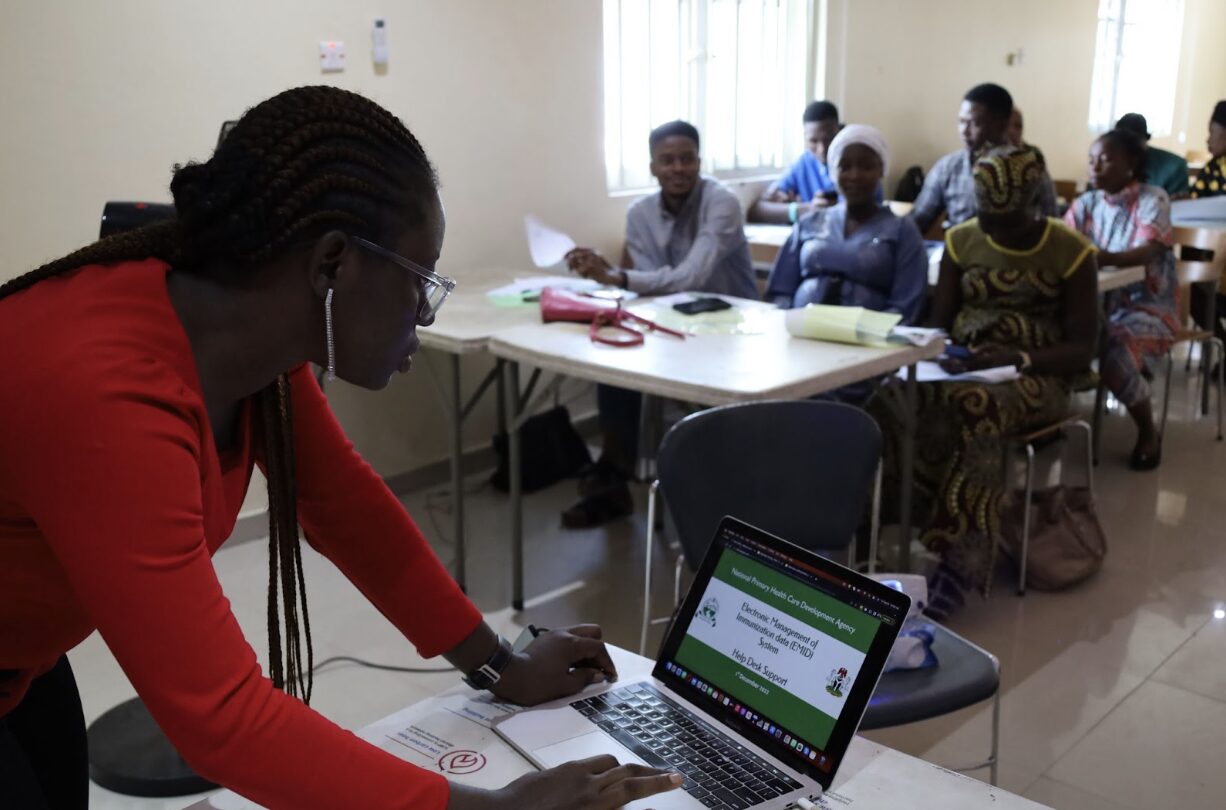
In collaboration with the ICT Unit at NPHCDA, eHA also trained users on help desk use and structure for issue resolution, support process flow, roles and responsibilities of the support tiers, and the use of support channels like email, Whatsapp and phone lines.  Specifically, the training focused on how to download and log into the application, how to conduct online and offline mode check, searching, filtering and updating of records, manual syncing, import and export of records. Participants were also shown how to navigate to the help section and the frequently asked questions (FAQs) on the native application. The optimized application ensures seamless management of vaccination data at national and subnational levels.

Health Checks; No More Sick Projects

By Juliana Jacob

Case Study

Mark was proud to be doing well on his project, so it surprised him when a meeting with stakeholders revealed that his team did not meet quality and project standards. Although Mark and his team were a brilliant team, they were not implementing the project as expected. 

Project Manager,  Mark is working on a three-year project in Jigawa State. Through the completion of the various activities highlighted at the beginning of this project, Mark and his team thought the project was on track. They had organized capacity-building workshops for immunization officers in select health facilities, but it was insufficient.

Mark organized a pause and reflect session with his team to analyze the project implementation phases and activities they had conducted. This was to enable them to identify loopholes. It was during the session that they concluded that they should have conducted regular health checks as a part of the project improvement plan. 

After working closely with the Project Quality Assurance (PQA) specialist, they created a robust improvement plan which included quarterly health checks as a key component. The project met quality standards in a short period after they began the implementation of the quality plan.

Just like Mark resolved with his team, Project teams and Project Managers at eHealth Africa employ the health check tool to checkmate projects’ health.

What is a project health check?

A project health check is a review of all projects to validate that projects are delivering on defined scope, processes, and agreed objectives. A project health check helps you assess the current state of any project and identify problems that could cause issues during the entire endeavor if left unattended. As a project manager, knowing the health of your team is crucial. Project Health Checks are a valuable means of assessing the likelihood of success  (or the risk of failure) of in-progress projects. They can provide a safety net and early warning system for senior management and for individual project managers by revealing environmental, structural, or intrinsic flaws in projects that, for those absorbed in managing them, are often difficult to recognize.

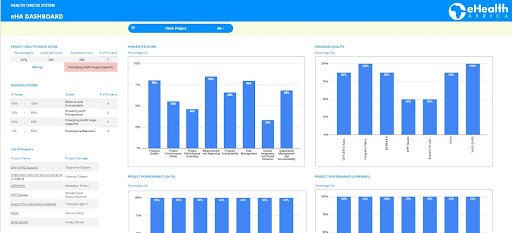
Our previous health check tool wasn’t able to give us all the information \when it was time to access a project as there weren’t many insight categories, with projects scoring 100% but defaulting on key quality areas. So we upgraded to a more improved version of the health check tool that could assess projects based on eight core project parameters with sub-parameters including external parameters and stakeholders’ feedback.

Introducing Health Check V2

This newly introduced eHealth Africa’s health check self-assessment tool caters to the need for a project improvement plan, providing the next steps to improve project quality. Rather than a situation where the Project Support team receives documents from project managers and conducts the assessment, this tool allows project managers and project teams to self-assess their projects.

Project Managers at eHA have widely welcomed the tool because of its improved categories and wider reach.

Mohammed Bello, a Project Manager, explained that he is excited because the tool will improve his work. “I am very excited to have this new tool to help improve my work.” He added that the tool is an upgrade from the previous one, “The new self-assessment tool is an improvement, and I particularly like it because it encompasses everything a project needs to do well.”

For Tahir Buhari, another Project Manager with eHealth Africa, the scoring metrics are what appeal to him. “It is more practical than the previous tool we used. The scoring metrics are a lot clearer and easier to self-assess.”

eHealth Africa’s goal of ensuring that all projects implemented meet standards resulted in an improved version of the Health Check assessment tool. Project Managers use this tool to identify when a project needs improvement and make changes when necessary. We have made this tool as simple as possible to use, while still maintaining quality. At eHealth Africa, we constantly design new tools that will improve our processes.