Press Release
eHealth Africa, WHO Strengthen Nigeria’s Disease Surveillance Capacity with Upgraded Laboratories in Maiduguri and Ibadan
For Immediate Release
eHealth Africa, in collaboration with the World Health Organization (WHO), has commissioned an upgraded Diagnostic and Genomic Sequencing Laboratory at the National Polio Laboratory in the University of Maiduguri Teaching Hospital (UMTH), Borno State, strengthening Nigeria’s disease surveillance and outbreak preparedness capacity.
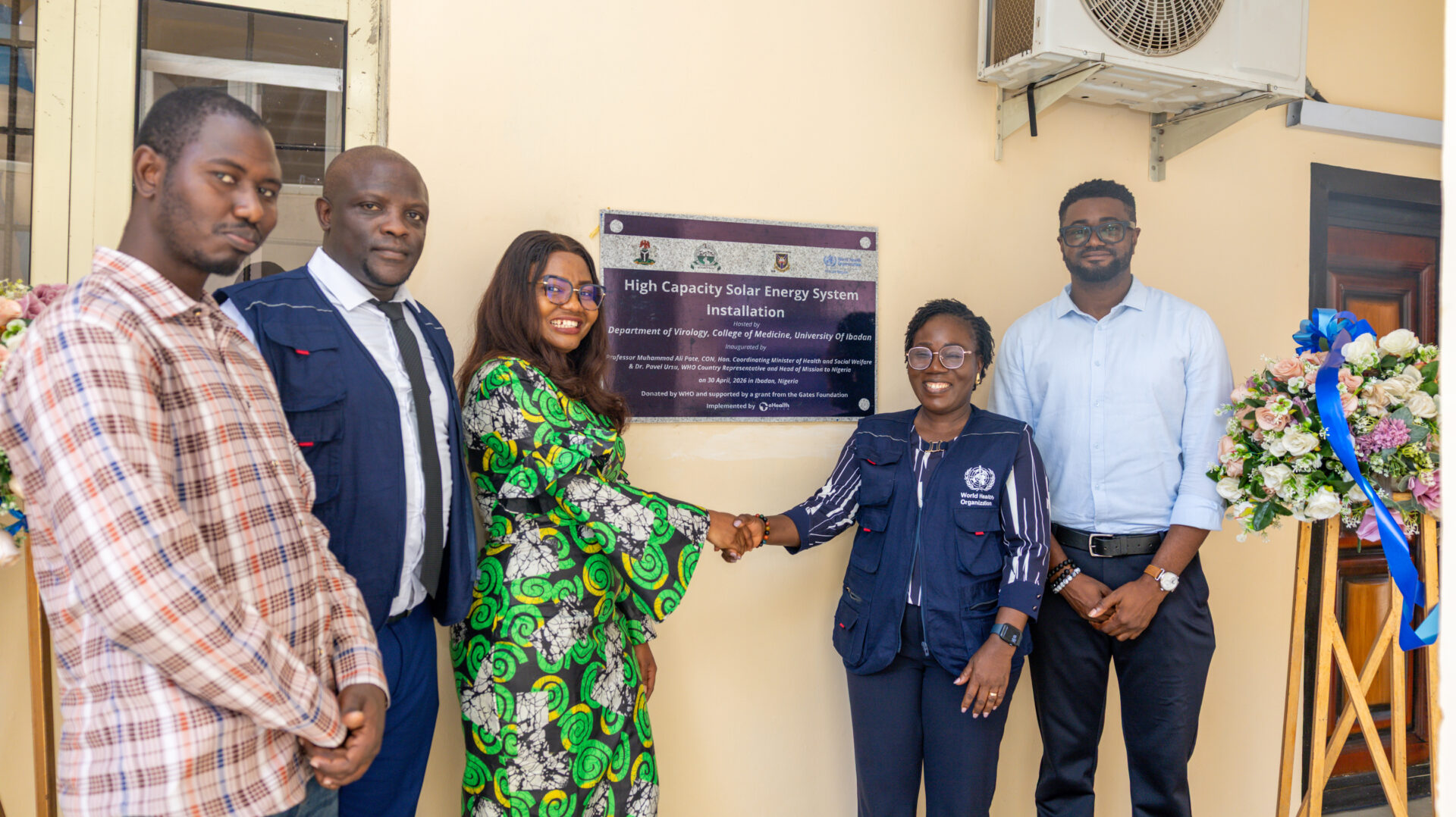
In a related intervention, partners also commissioned a major solar power upgrade at the sequencing laboratory in the Virology Department of the University College Hospital (UCH), Ibadan, to support uninterrupted laboratory operations and genomic surveillance activities.
The interventions reflect growing investments in resilient public health infrastructure capable of withstanding climate-related disruptions while strengthening rapid outbreak detection and response systems across Nigeria and the wider West African region.
The upgraded laboratory at UMTH was commissioned by the Coordinating Minister of Health and Social Welfare, Professor Muhammad Ali Pate. The facility now features advanced genomic sequencing capabilities, enhanced Information and Communication Technology (ICT) systems, and solar-powered infrastructure designed to support uninterrupted operations and improve disease surveillance capacity.
The commissioning followed severe flooding in Maiduguri in September 2024, which disrupted operations at the National Polio Laboratory and caused significant damage to critical equipment at a time when rapid disease surveillance and response were urgently needed.
With funding support from the Gates Foundation and technical support from the WHO Regional Office for Africa, eHealth Africa restored and upgraded the laboratory into a more climate-resilient and future-ready public health facility.
Speaking during the commissioning, Professor Pate said the upgraded facility represents a major investment in Nigeria’s outbreak preparedness and laboratory systems strengthening efforts.
“The upgrade of this facility is not only important for polio surveillance, but also for preparedness against future outbreaks. The fact that we have a facility of this stature is an excellent development not only for Nigeria, but for West Africa,” he said.
He added: “The fact that this facility can produce results that align with international reference standards demonstrates the quality of expertise and infrastructure being built here at UMTH.”
Speaking on the intervention, Agwu Chijioke, Associate Manager, Laboratory Systems and Diagnostics at eHealth Africa, said the restoration became necessary following the devastating floods that damaged the facility and disrupted operations.
“Partners came together to urgently restore and expand the laboratory while ensuring the upgraded facility is better equipped to withstand similar incidents in the future. This demonstrates the importance of sustained collaboration in strengthening resilient health systems,” he said.
Attention also turned to the University College Hospital (UCH), Ibadan, where partners commissioned a high-capacity solar power upgrade to support uninterrupted sequencing and surveillance operations.
Building on earlier laboratory upgrades implemented in 2023 with support from WHO, eHealth Africa further strengthened the facility through a solar infrastructure intervention funded by the Gates Foundation to ensure reliable and sustainable power supply for critical laboratory operations.
Representing the Coordinating Minister of Health and Social Welfare at the commissioning in Ibadan, Dr. Audu Idowu, Deputy Incident Manager at the National Emergency Operations Centre, said the intervention aligns with the ministry’s vision to strengthen Nigeria’s genomic sequencing capacity.
“With this high-capacity solar system now in place at the Ibadan National Polio Laboratory, we have the reliable and uninterrupted power required to sustain critical sequencing and surveillance activities,” he said.
Speaking on the solar installation, eHealth Africa Project Manager, Chinyenyenwa Henshaw, said the intervention addresses the critical need for a reliable power supply in laboratories handling sensitive diagnostic and sequencing operations.
“The laboratory now operates primarily on renewable energy, helping to ensure sample integrity and protect sensitive equipment,” she said.
She added that the installation includes a 137-kilowatt peak solar photovoltaic system and a 320-kilowatt-hour battery storage system designed to provide uninterrupted renewable energy for laboratory operations.
“We have also trained local personnel and secured long-term warranties to help ensure the sustainability of the facility for years to come,” she added.
Also speaking at the event, Dr. Sachin Rewaria, Surveillance Officer at the World Health Organization, said reliable laboratory operations remain critical to timely outbreak response and surveillance effectiveness.
“The commissioning of this high-capacity solar system offers significant operational and public health advantages by helping to maintain the speed, quality, and reliability of surveillance activities,” he said.
Dr. Bernard Onoja, Laboratory Coordinator at UCH, described the intervention as a significant milestone in strengthening Nigeria’s public health infrastructure and laboratory research capacity. “Our poliovirus isolation and sequencing capacity has been significantly enhanced, enabling timely, accurate, and high-quality surveillance outputs that support national and global polio eradication efforts,” he said.
The commissioning of the upgraded laboratories in Maiduguri and Ibadan reflects a broader commitment by eHealth Africa, WHO, and partners to strengthen Nigeria’s public health infrastructure through resilient, technology-driven systems. The interventions also underscore the importance of sustained collaboration between government, development partners, and local institutions in building future-ready health systems capable of responding to evolving public health challenges across Nigeria and the wider West African region.
About eHealth Africa
eHealth Africa (eHA) is a nonprofit organization strengthening health systems across Africa through data-driven solutions and digital innovation. For more than 15 years, eHA has supported governments and partners to address public health challenges through scalable technology, operational expertise, and strategic collaboration. eHA operates across 26 African countries, including Chad, Liberia, Cameroon, Tanzania, Madagascar, and Zimbabwe.
For more information, visit: https://ehealthafrica.org/
Media Contact:
Favour Oriaku
Communications Manager, eHealth Africa
Favour.oriaku@ehealthafrica.org