Events
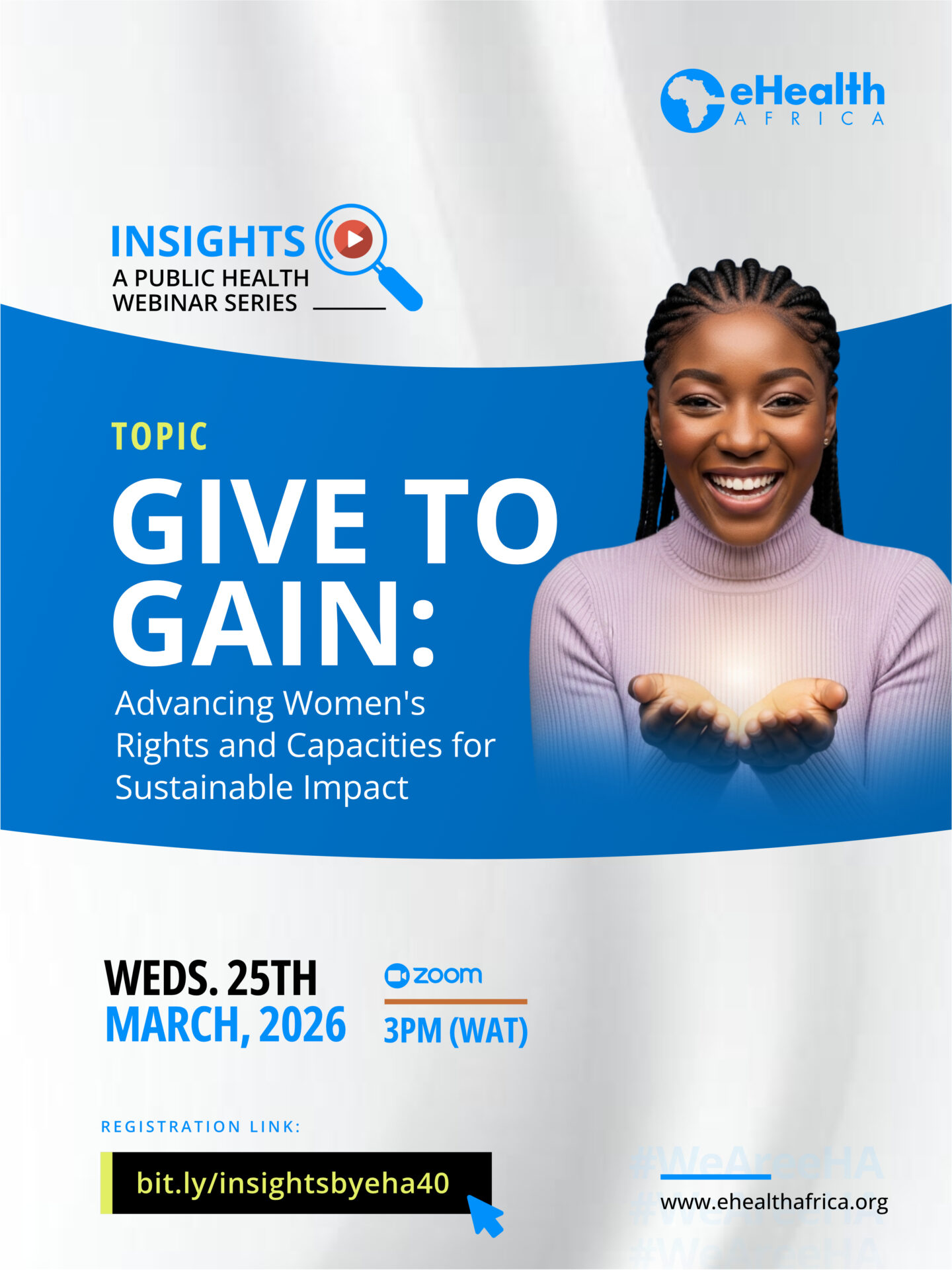
Insights: Advancing Women’s Rights and Capacities for Sustainable Impact
Moderator:
Joyce Shinyi– Communications Associate, eHealth Africa
Panelists:
Nuzo Eziechi – Senior Manager, Talent and Performance, eHealth Africa
Hannatu Balarabe Saidu – Project Manager, Girl Child Program, Maina & Kids Children Foundation
Augustina Okpechi – Project and Communication Lead, KSH Foundation
Summary
The Insights Webinar for April 2026 is titled; “Advancing Women’s Rights and Capacities for Sustainable Impact”. The session explored practical pathways for strengthening women’s empowerment through intentional investment, systemic change, and community-driven action. The discussion emphasized moving beyond advocacy to measurable, long-term impact across health, economic participation, and leadership.
Opening the conversation, panelists reflected on the theme “Give to Gain,” highlighting that true growth comes not only from receiving but from actively creating opportunities for others. Project and Communication Lead, KSH Foundation, Augustina Okpechi emphasized that giving extends beyond financial support to include mentorship, access, representation, and creating safe spaces. She described giving as a cycle that drives collective advancement and challenges individuals to intentionally open doors for others.
From a systems perspective, Senior Manager, Talent and Performance, eHealth Africa , Nuzo Eziechi stressed that advancing women’s rights requires both structural reforms and enabling ecosystems. She highlighted the importance of access to education, healthcare, economic opportunities, and leadership representation, alongside mentorship, networks, and continuous learning. She underscored that inclusion must be intentional and data-driven, noting that “without data, equity conversations remain abstract.” Drawing from organizational practice, she illustrated how deliberate policies such as leadership pipelines, flexible work structures, and measurable targets can translate commitment into tangible outcomes.
Hannatu Balarabe Saidu brought a strong community lens, identifying cultural norms, limited access to education, poor healthcare access, and underrepresentation in leadership as persistent barriers, particularly in underserved regions. She emphasized that sustainable impact requires grassroots engagement, patience, and trust-building. According to her, working through community leaders, continuous follow-up, and prioritizing long-term investment over short-term visibility are critical for success.
The panel also addressed the gap between advocacy and accountability, noting that while awareness is important, real progress depends on action, monitoring, and measurable outcomes. Augustina highlighted the need for collective responsibility among women, stressing solidarity, accountability, and intentional collaboration as key drivers of sustainable empowerment.
Across the discussion, several priority areas emerged, including addressing gender-based violence, improving access to quality healthcare, closing educational gaps, and increasing women’s representation in leadership and decision-making spaces. Panelists agreed that empowering women leads to broader societal benefits, strengthening institutions, economies, and communities.
The session concluded with a strong call to action: to institutionalize gender equity through data, policy, and leadership accountability; invest in younger generations; and prioritize community-based, long-term interventions. Ultimately, achieving sustainable impact requires a shift from symbolic efforts to intentional, measurable change driven by collaboration across all levels of society.